

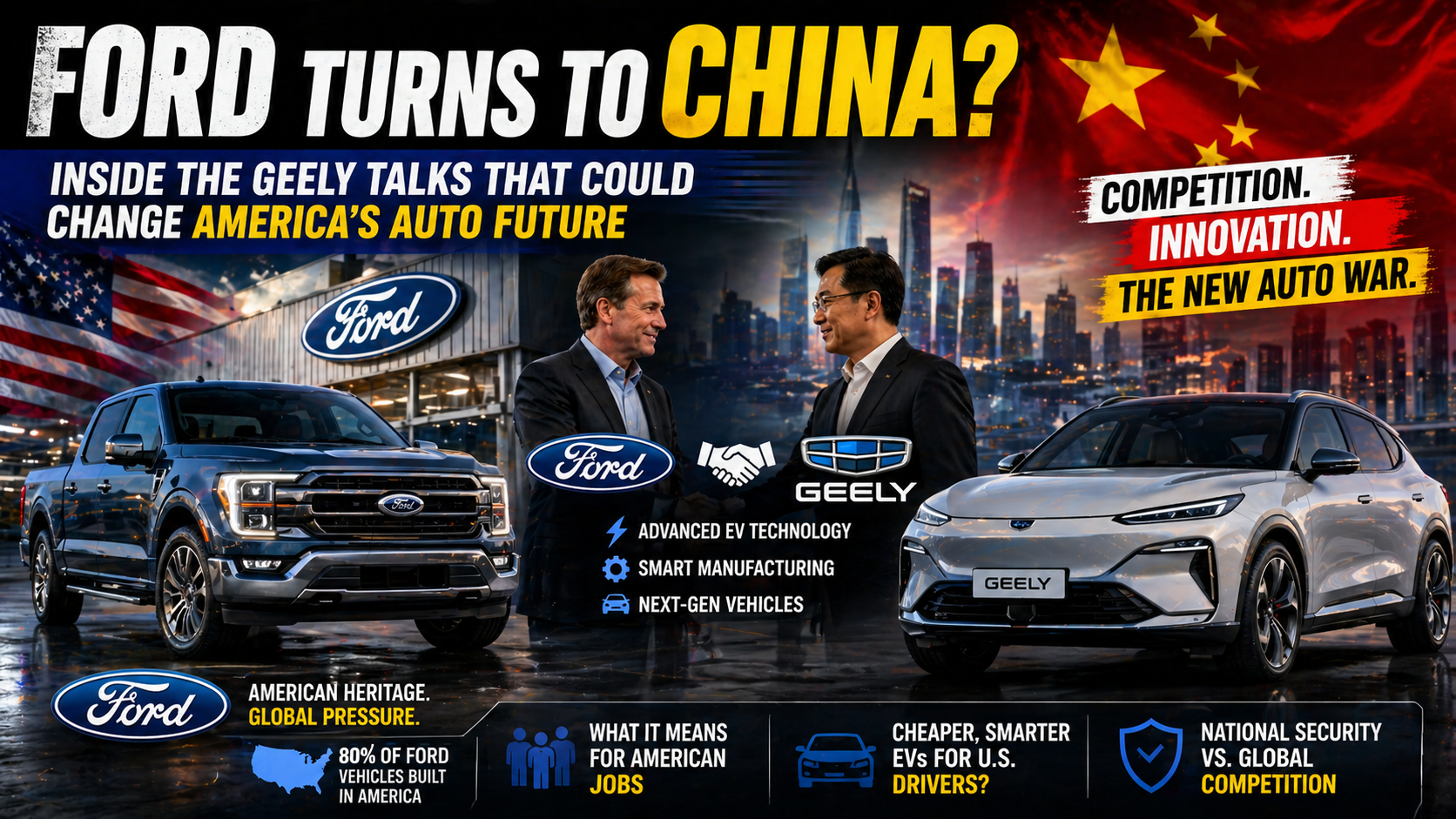
For over a century, Ford Motor Company has stood as a symbol of American manufacturing power.
It built the middle class, dominated highways, and proudly carried the label:
👉 “The most American automaker.”
But in 2026, something unexpected is happening.
Ford may be looking east — toward China.
🌍 The Talks That Shocked the Industry
Recent reports reveal that Ford Motor Company has been in discussions with Geely — one of China’s biggest automotive giants.
The idea?
👉 Potentially bringing Chinese vehicle technology into U.S.-market Ford cars
While talks are not fully confirmed and may have stalled, the message is clear:
Ford is exploring new ways to stay competitive in a rapidly changing global auto market.
⚡ Why Would Ford Do This?
At first glance, it seems controversial.
Why would an American icon turn to a Chinese partner?
The answer lies in one word: competition.
Chinese automakers have surged ahead in:
- EV technology
- Battery efficiency
- Cost-effective production
Companies like BYD and Geely are producing cheaper, tech-heavy electric vehicles that are gaining global market share
Meanwhile, U.S. automakers face:
- Higher production costs
- Slower EV rollout
- Increasing global pressure
👉 For Ford, partnering could mean closing the technology gap faster.
🇺🇸 The Political and Economic Tension
This isn’t just a business story — it’s political.
Right now, the U.S. has:
- High tariffs on Chinese-made vehicles
- Restrictions on Chinese automotive software
These rules are designed to protect American jobs and manufacturers
So if Ford integrates Chinese technology, it raises big questions:
- Will it impact U.S. jobs?
- Does it conflict with national security concerns?
- Can Ford still claim to be “Made in America”?
Ford itself produces about 80% of its U.S. vehicles domestically, far above the industry average
That’s what makes this situation so sensitive.
🏭 A Strategy Shift, Not a Weakness?
Instead of seeing this as desperation, some experts see it as strategy.
The global auto industry is changing fast:
- EV transition is expensive
- Software is becoming more important than hardware
- Partnerships are becoming normal
Even rivals are doing it:
- GM has built vehicles in China before
- European automakers partner with Chinese firms regularly
👉 In today’s world, collaboration may be the only way to compete globally.
🔮 What This Means for American Drivers
If this partnership (or something similar) happens, it could lead to:
🚗 Cheaper EVs
Chinese tech could reduce production costs → lower prices for consumers
⚡ Better Technology
Faster innovation in:
- Batteries
- Autonomous driving
- Smart features
🇺🇸 Industry Shake-Up
More competition → pressure on Ford, GM, and Tesla
⚠️ The Risk Factor
But there’s a flip side.
This move could:
- Trigger political backlash
- Hurt Ford’s “American brand” image
- Face regulatory hurdles
And perhaps most importantly:
👉 It could redefine what “American car” really means.
🚀 Final Take
The talks between Ford Motor Company and Geely aren’t just another business deal.
They represent a turning point.
A moment where:
- Tradition meets globalization
- Legacy meets innovation
- And America’s auto identity faces a new question
👉 Can the most American car company stay on top… without going global?