

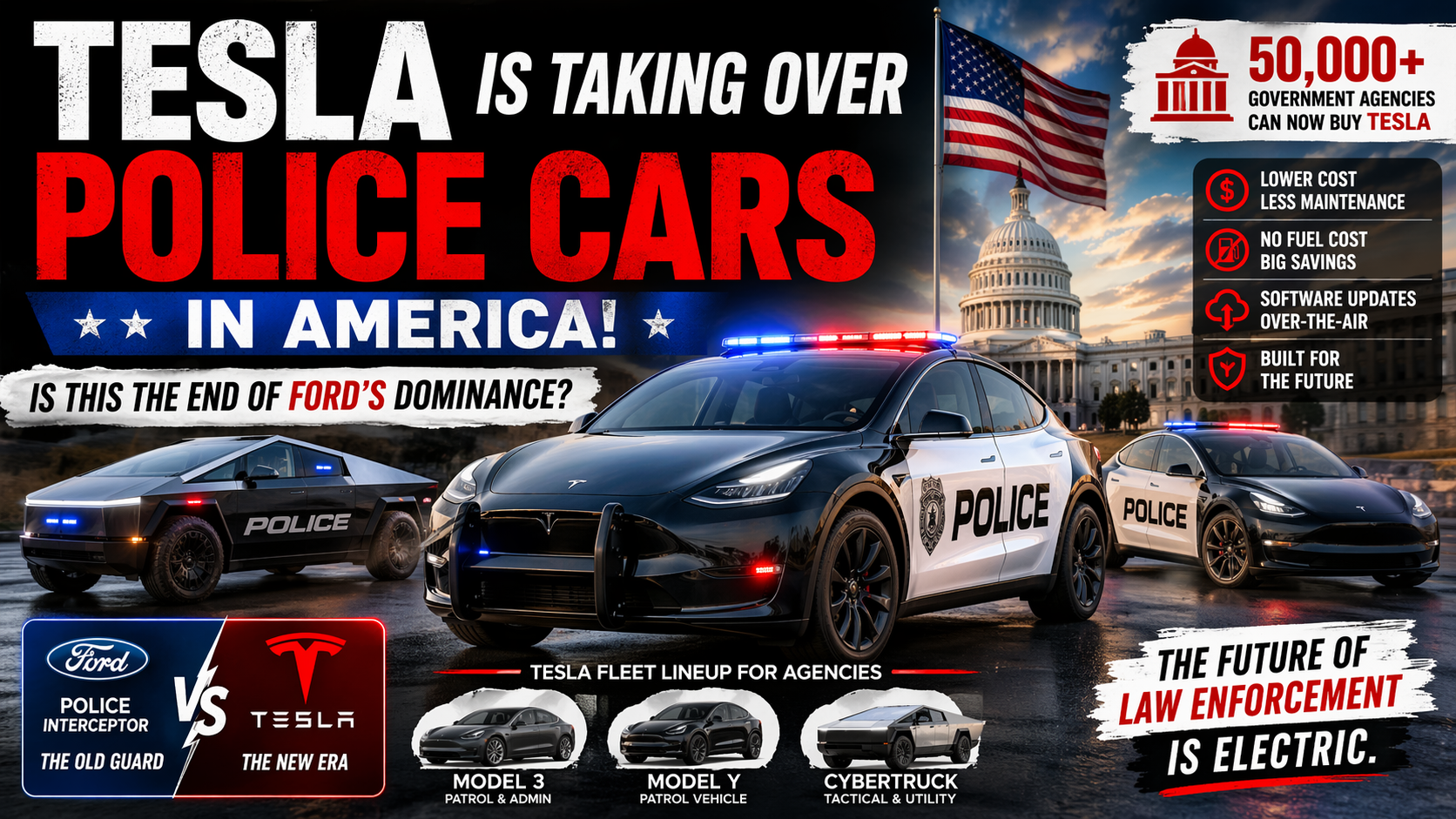
For decades, if you saw a police car in America, chances are it came from Ford Motor Company or General Motors.
The iconic Ford Police Interceptor became a symbol of law enforcement itself.
But in 2026, that story is starting to change.
And the company rewriting it?
👉 Tesla, Inc.
🚨 A Silent Entry That Could Change Everything
Tesla has quietly stepped into one of the most stable and lucrative automotive segments in America — government and police fleets.
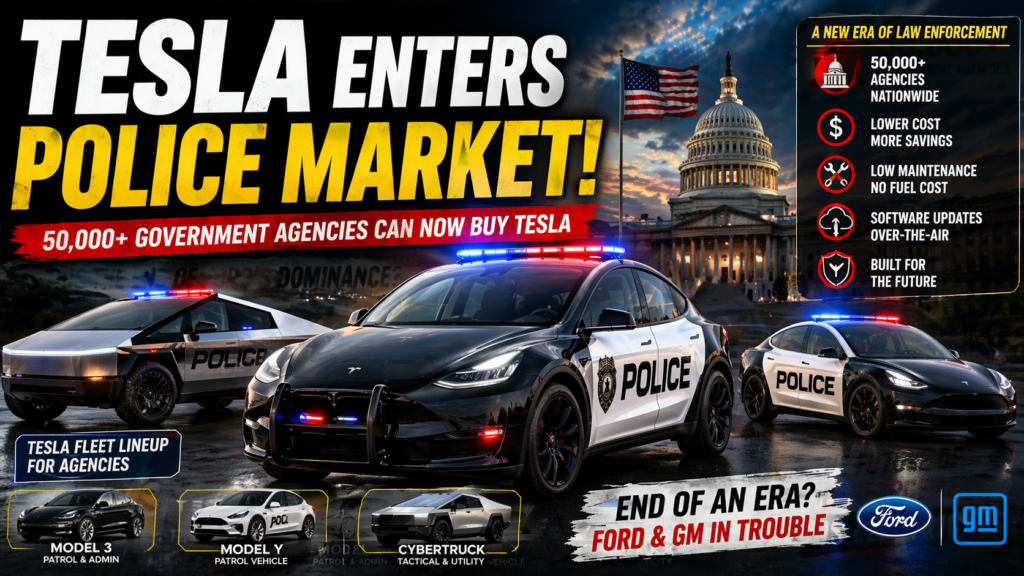
Through a major partnership with Sourcewell, Tesla vehicles are now available to over 50,000 public agencies across the United States.
That includes:
- Police departments
- State agencies
- Schools and municipalities
And here’s the game-changing part:
This system allows agencies to purchase Tesla vehicles without the traditional lengthy bidding process.
In simple terms — Tesla didn’t knock on the door.
It walked straight in.
🚓 From Patrol Streets to Electric Power
Tesla isn’t just selling cars — it’s targeting real police use cases.
Departments across the U.S. have already begun testing:
- Tesla Model Y as patrol vehicles
- Tesla Model 3 for administrative and urban policing
- Tesla Cybertruck for rugged, tactical, and utility roles
This signals something bigger than a product launch —
👉 It’s the beginning of electric policing infrastructure.
💥 Ford and GM’s Long-Standing Monopoly at Risk
For years, Ford Motor Company and General Motors have dominated the government fleet market.
From police interceptors to municipal vehicles, they controlled a multi-billion-dollar ecosystem.
But Tesla’s entry changes the equation:
- Direct access to thousands of agencies
- A strong EV brand image
- Lower operating costs
This isn’t just competition.
👉 It’s disruption.
⚡ Why Government Agencies Are Paying Attention
Electric vehicles bring a completely different cost structure — and that’s where Tesla shines.
Here’s why agencies are considering the switch:
- No fuel costs → major long-term savings
- Lower maintenance → fewer moving parts
- Over-the-air updates → software improvements without downtime
- High safety ratings
Tesla is even offering incentives like reduced delivery fees, making adoption easier.
📉 The Bigger Picture: Why Tesla Needs This Move
Tesla’s expansion into government fleets isn’t random.
With EV competition rising globally and consumer demand fluctuating, Tesla is:
👉 Exploring stable, large-scale buyers
Government contracts offer:
- Predictable demand
- Bulk purchasing
- Long-term partnerships
It’s a strategic pivot — not just a new market.
⚠️ Challenges Ahead
Despite the momentum, Tesla still faces real hurdles:
- Limited fleet financing options
- State-level restrictions on direct vehicle sales
- Concerns over durability in high-speed, high-stress police conditions
And perhaps the biggest question:
👉 Can EVs truly replace traditional police vehicles in every scenario?
🔮 What Happens Next?
If Tesla succeeds, we could see a massive shift:
- Police fleets going electric faster than expected
- Decline of gasoline-powered patrol vehicles
- Increased competition from Ford and GM in EV police cars
The streets of America may soon sound very different —
Less engine roar, more silent acceleration.
🚀 Final Take
Tesla’s move into the government fleet market isn’t just another business expansion.
It’s a signal.
A signal that the future of law enforcement vehicles may no longer belong to legacy automakers —
but to a company that built its name on disruption.