

For years, buying a new vehicle in America has felt like signing up for a second mortgage.
Walk into almost any dealership today and you’ll quickly discover that even “affordable” vehicles often cost more than $35,000. Add technology packages, premium trims, dealer markups, and financing, and many buyers simply walk away.
Now a little-known startup from Michigan believes it has the answer.
Not with a luxury electric SUV.
Not with a futuristic robotaxi.
And definitely not with another six-figure electric pickup.
Instead, the company is betting everything on something the American auto industry almost forgot how to build—a simple truck.
Meet the Truck That Has America Talking
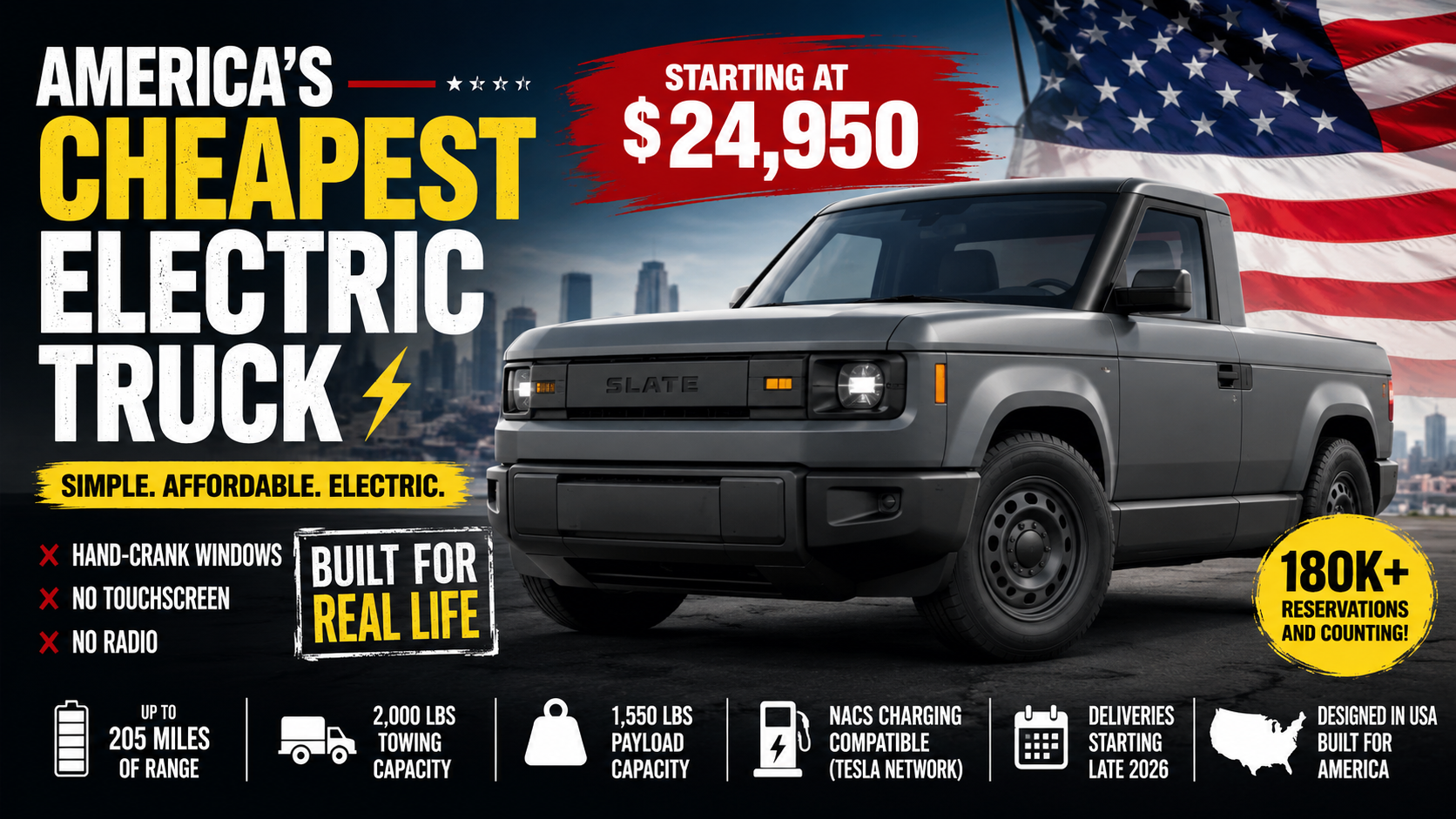
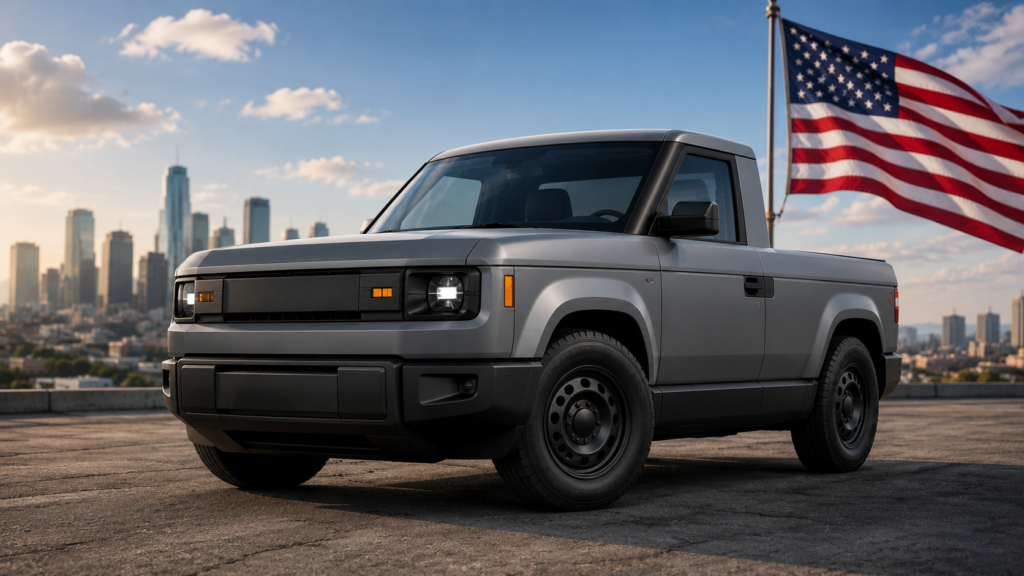
Slate Auto has officially revealed pricing for its first electric pickup, starting at $24,950, making it one of the least expensive new trucks available in America today.
At first glance, it almost feels like a vehicle from another era.
It has:
- Manual hand-crank windows
- No built-in touchscreen
- No factory stereo
- Physical climate controls
- Two seats
- Rear-wheel drive
- Compact dimensions smaller than most modern pickups
That sounds almost unbelievable in 2026.
Yet that’s exactly why thousands of Americans suddenly can’t stop talking about it.
Instead of asking, “What luxury features can we add?”
Slate asked a completely different question:
“What can we remove to finally make a truck affordable again?”
Americans Are Tired of Expensive Vehicles
The average new vehicle in America now costs well over $45,000, while electric vehicles remain even more expensive on average.
For many families, monthly car payments have become one of their biggest household expenses.
Slate believes millions of buyers don’t actually need giant touchscreens, powered tailgates, ambient lighting, or dozens of driving modes.
They simply need reliable transportation.
That philosophy has resonated faster than many industry experts expected.
The company says it has already collected more than 180,000 reservations, an impressive figure for a startup that hasn’t delivered its first customer truck yet.
Built Like a Blank Canvas
Perhaps the smartest part of Slate’s strategy isn’t the truck itself.
It’s what happens after you buy it.
Instead of forcing customers to purchase expensive trim levels, Slate plans to sell more than 200 accessories that owners can install over time.
Want speakers?
Add them later.
Need roof racks?
Order them when you actually need them.
Want an SUV instead of a pickup?
Slate even plans to offer conversion kits that transform the truck into a five-passenger SUV.
The company calls this approach “We Built It. You Make It.”
It’s closer to building your own PC than buying a traditional automobile.
Simplicity Doesn’t Mean Weak
Despite its minimalist design, the truck still offers practical capability.
Expected highlights include:
- Around 205 miles of estimated driving range
- Approximately 2,000 pounds of towing capacity
- Roughly 1,550 pounds of payload capacity
- Compatibility with Tesla’s NACS charging network and Superchargers
- Air conditioning
- Backup camera
- Cruise control
In other words, Slate removed the luxury—not the essentials.
The Timing Couldn’t Be More Challenging
Launching an affordable EV has never been easy.
Slate now faces several major hurdles.
Federal EV tax credits have changed, increasing the effective purchase price compared with the company’s original vision.
New tariffs have also increased costs for imported components.
Meanwhile, EV sales growth has slowed as buyers increasingly favor hybrids.
Even established automakers are rethinking their electric vehicle strategies.
Yet Slate believes affordability—not luxury—is the missing ingredient in today’s EV market.
Can Slate Really Succeed?
History offers reasons for caution.
America has seen ambitious EV startups rise quickly—and disappear just as fast.
Building prototypes is difficult.
Building thousands of reliable vehicles every month is much harder.
Manufacturing, supplier relationships, quality control, warranty costs, and customer service have defeated more than one promising startup.
Slate plans to begin customer deliveries in late 2026 from its manufacturing facility in Indiana, where the company is preparing for large-scale production.
Why This Truck Matters Beyond EVs
Whether Slate succeeds or fails, the company may have already changed one important conversation.
For years, the industry focused on making vehicles smarter, bigger, and more expensive.
Slate is asking something refreshingly different:
What if Americans simply want affordable transportation again?
That question extends beyond electric vehicles.
It challenges the entire direction of the U.S. auto industry.
If enough buyers embrace simplicity over luxury, other manufacturers may be forced to rethink their pricing strategies and bring genuinely affordable vehicles back to American roads.
Final Thoughts
The Slate Truck isn’t trying to out-muscle heavy-duty pickups.
It isn’t trying to beat performance EVs in acceleration.
Instead, it’s attempting something arguably more difficult—bringing affordability back to the American auto market.
In an era when nearly every new vehicle seems loaded with expensive technology, Slate’s biggest innovation might actually be what it left out.
And judging by the growing reservation list, many Americans have been waiting for exactly that.